
Why Financial Titles Confuse Everyday People
01.The 'Alphabet Soup' Problem
Walk down any main street or scroll through social media, and you will see dozens of people calling themselves 'Financial Advisors,' 'Wealth Coaches,' 'Investment Consultants,' or 'Retirement Planners.' To an ordinary family, they all sound identical. Yet behind the scenes, they may hold completely different licenses, answer to different government regulators, and get paid in opposite ways.
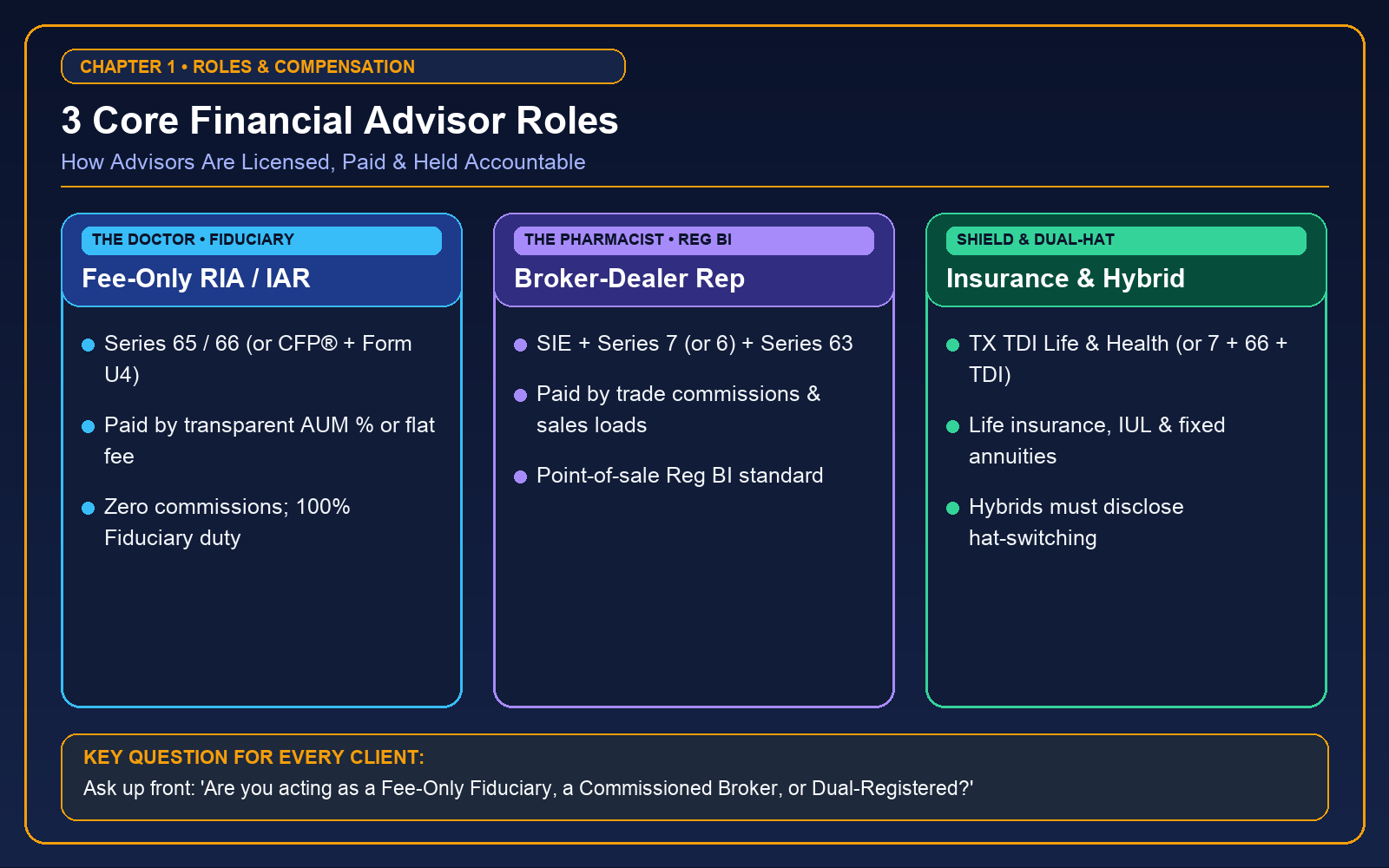
02.The Doctor vs. Pharmacist Analogy
The easiest way to understand financial professionals is to compare them to healthcare: • A Fee-Only Investment Adviser (RIA) is like your Primary Care Doctor: you pay them a transparent fee for a complete diagnosis, a long-term treatment plan, and continuous year-round checkups. They cannot take kickbacks from drug companies. • A Broker-Dealer Representative (Stockbroker) is like a Licensed Pharmacist: when you need a specific product (a stock, bond, or mutual fund), they fill the order safely and earn a commission on that product. • A Licensed Insurance Agent is like a Home-Shield Specialist: they build contractual safety floors around your family (life insurance and guaranteed annuities) and are paid a commission by the insurance carrier.
03.Client & Advisor Takeaway
• For Clients: Never judge an advisor by a business card title alone—always look at their legal registration and how they are compensated. • For Advisors: Always introduce your role and compensation model in plain language during the very first prospect conversation.